

What is Blood Flow Restriction Therapy?
Blood Flow Restriction (BFR) therapy is an advanced treatment technique available through the professionals in the Pipestone County Medical Center (PCMC) therapy department. This cutting-edge service utilizes specialized equipment to deliver remarkable results for patients recovering from injuries, surgeries, or conditions causing muscle loss or deconditioning.
At the core of this treatment is the application of a specialized tourniquet cuff, which is placed on the upper arm or leg to reduce arterial inflow and restrict venous outflow. “Exercising in this manner allows us to use low-intensity exercise to achieve improvements in muscle size, strength, or endurance that are typically associated with much heavier loads or higher intensities,” explains Kyle Hailey, Physical Therapy Assistant at PCMC.
Benefits for a Range of Patients
BFR therapy offers significant benefits for a diverse group of patients. According to Hailey, the treatment supports muscle growth, improves bone density, reduces soreness, enhances cardiovascular health, and alleviates pain. “BFR is beneficial for anyone who has weight-bearing restrictions or who is unable to effectively load a muscle—whether due to surgery, injury, or deconditioning,” Hailey shares.
In addition to aiding athletes, BFR therapy provides vital support for older adults, individuals with chronic pain, and those with conditions that lead to muscle loss. Hailey adds, “BFR can be a game-changer for these populations, helping them regain strength and functionality with minimal physical stress.”
Enhanced Technology for Superior Care
PCMC’s recent acquisition of Delfi units has elevated the quality of BFR therapy offered to patients. These state-of-the-art devices deliver consistent pressure throughout exercises, ensuring safety and effectiveness. “The Delfi system is validated by research and allows us to maintain precise and consistent pressure, which is essential for optimal outcomes,” Hailey notes.
A Patient-Centered Approach
During a BFR therapy session, patients can expect a highly personalized experience. “We start by determining the patient’s limb occlusion pressure, which measures the lowest pressure needed to stop blood flow in a limb,” Hailey explains. “Exercises are performed at 80% occlusion for the lower extremity and 50% for the upper extremity. The sessions involve low resistance and high repetitions, which fatigue the targeted muscles. Patients often achieve similar—or even better—results compared to high-intensity training.”
Expert Training and Certification
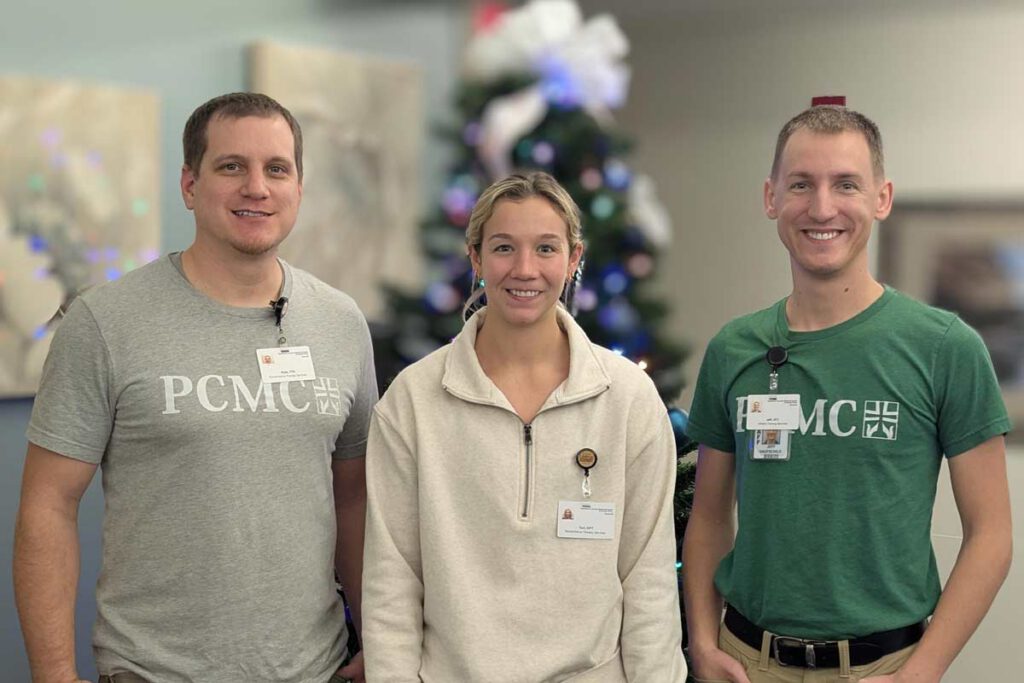
Every PCMC therapy team member is trained to administer BFR therapy, ensuring patients receive care from skilled professionals. Additionally, Hailey, Tori Knowles, a physical therapist, and Jeffrey Haufschild, an athletic trainer, have completed certification courses. “To become certified, we attended a weekend course covering the physiology of BFR, cuff selection, application of pressure, exercise programming, and safety considerations,” Hailey explains.
This dedication to advanced training underscores PCMC’s commitment to providing exceptional care. The therapy team’s expertise ensures patients receive safe, effective, and individualized treatment.
Whether you’re an athlete, an older adult, or recovering from surgery, BFR therapy at PCMC could be the key to regaining strength and mobility.